
Here’s the privacy paradox of AI. The more it knows about your situation, the better it helps. The more it knows about you, the more you’ve given away.
Most privacy advice says “don’t share anything.” Follow that and AI turns into a generic search engine. Ignore it and you may be handing over more than you meant to, a piece at a time.
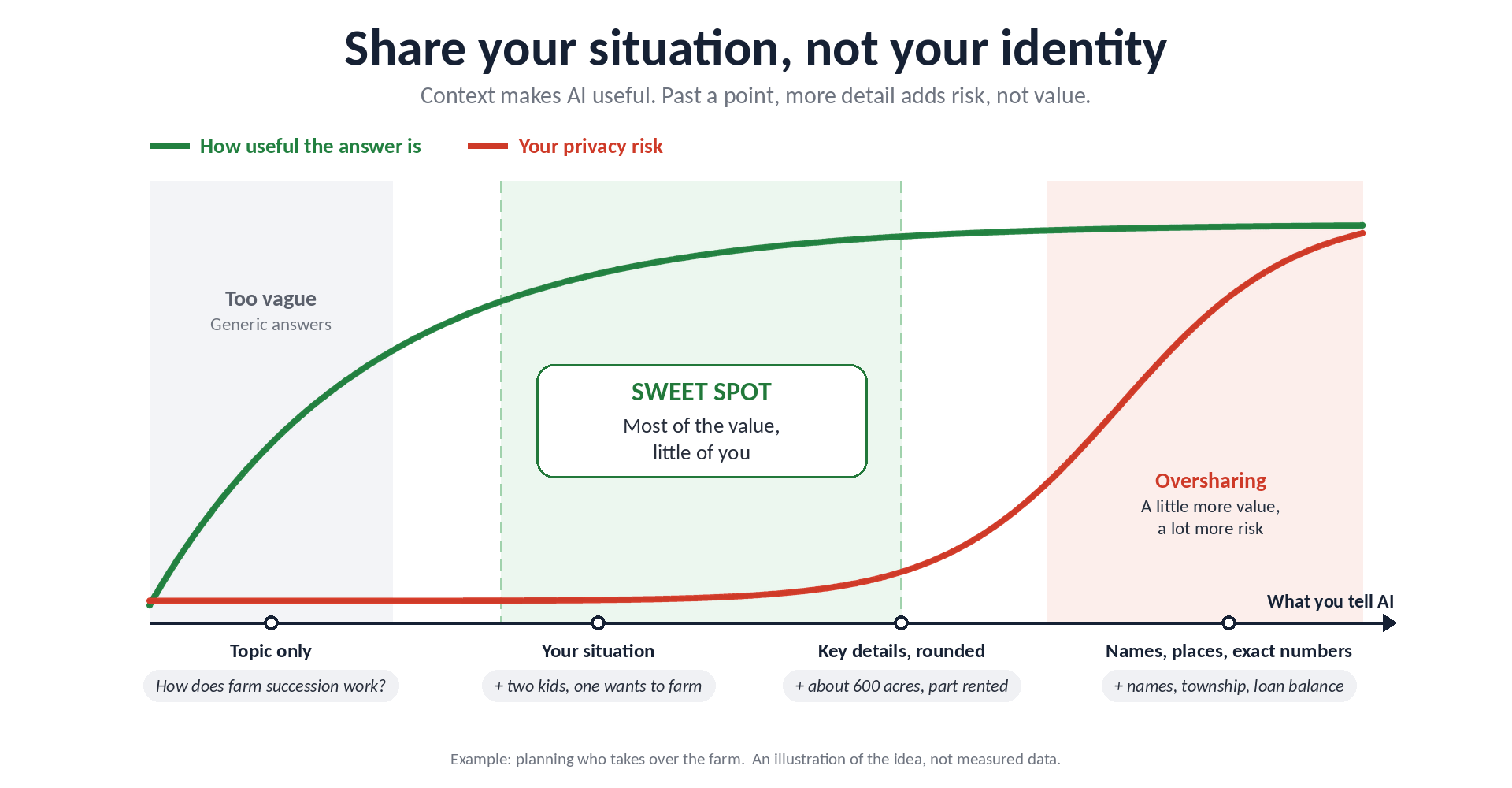
There’s a middle path, and it comes down to one habit: share your situation, not your identity. AI needs to know you have two kids and only one wants to farm. It doesn’t need their names, your township or your loan balance.
This isn’t about stopping AI from learning from you. Plenty of people don’t mind that. It’s about limiting what it learns about you.
There’s a lot to cover, so we’ve split this guide in two. This part explains why privacy works differently with AI than most people expect: how harmless details add up, and where your chats can end up. Part 2 covers what to do about it: four settings worth checking and six habits for what you type.
The short version
- AI isn’t a search box. You talk to it like a person, and it can remember, connect and keep what you say.
- Privacy is a spectrum. The red items are easy to spot. Most of what you share sits in an orange middle: harmless alone, revealing together.
- The mosaic effect. Small pieces from many chats can add up to a profile, including things you never said.
- Your chats can travel: into memory, ad systems, human review, work accounts, court cases, third-party apps and the open web.
- None of this means you should quit AI. It means sharing your situation, not your identity. Part 2 shows how.
Why AI is different from a search engine
Most of us have years of privacy habits online. We know not to post a SIN on Facebook, and we don’t think twice about typing “corn nitrogen rate” into Google. AI chat quietly breaks those habits, in four ways.
It listens like a person
A search box gets three words. A chatbot gets the whole story. It answers kindly, asks follow-up questions, and never seems in a hurry, so people tend to share more the longer they talk. You’d never type “my son doesn’t want to take over the farm” into Google. You might tell a chatbot at 11 at night.
It remembers
Many AI apps now have memory: they save facts about you and bring them into later chats. That’s why the tenth conversation can feel smarter than the first. It also means something you mentioned in March can shape an answer in September.
It connects the dots
Filling in gaps is what AI is built to do. Give it a few facts and it builds the most likely story around them. That’s exactly what you want when the story is about your soil test. It’s less comfortable when the story is about you.
It keeps
Your chats are stored on a company’s servers, sometimes for years, and settings decide who can see them and for how long. Deleting a chat from your screen doesn’t always delete every copy.
| Search engine | AI chat | |
|---|---|---|
| What you give it | A few keywords | Your whole situation, often in detail |
| What it does | Finds pages | Works it through, and may remember it |
| Filling in gaps | Doesn’t | Does, by design |
| Feels like | A tool | A conversation |
Privacy is a spectrum, not yes or no
Most people sort information into two piles: private and not private. In practice it’s a spectrum, and most of what you’d tell AI sits in the middle.
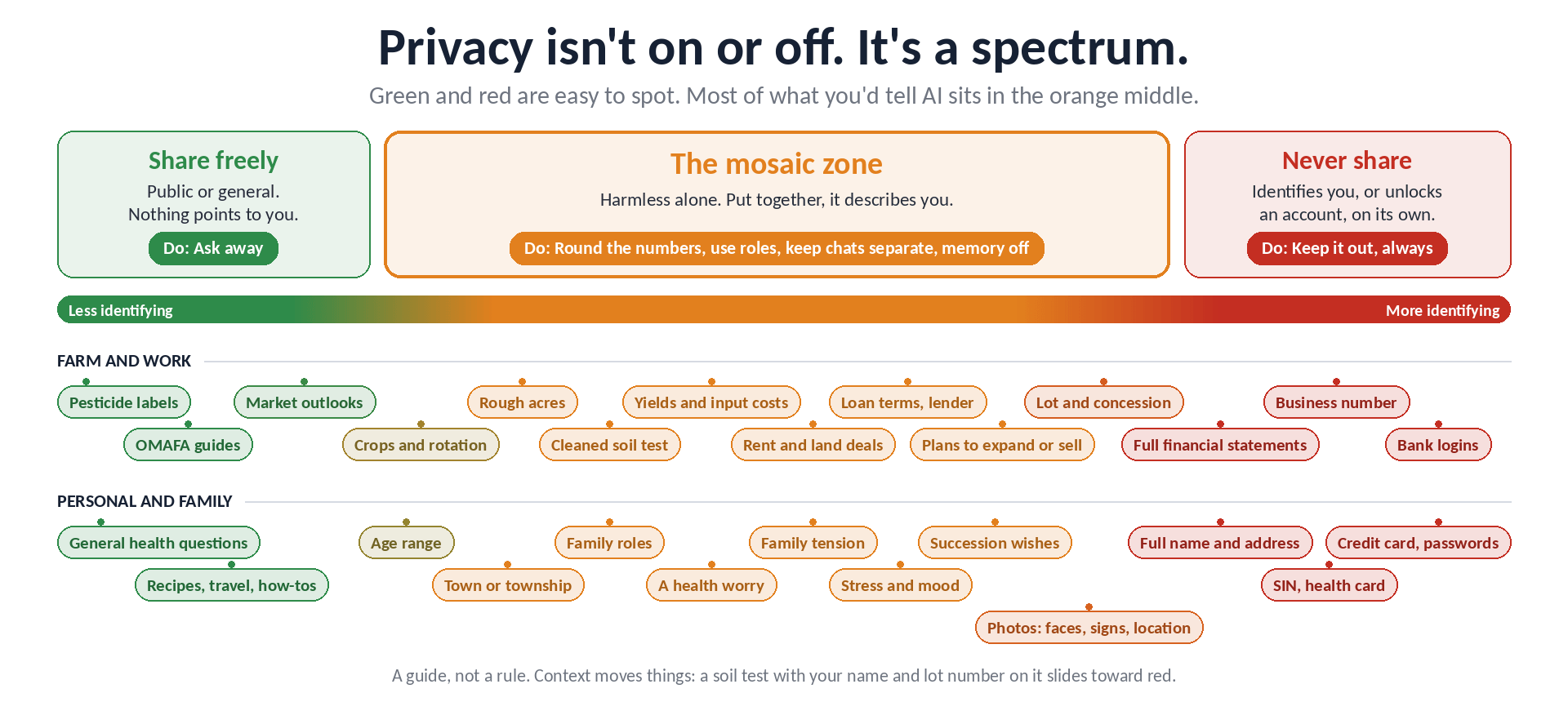
- Green: share freely. Pesticide labels, OMAFA guides, market outlooks, recipes, how-to questions. Nothing here points back to you.
- Red: never share. Your SIN, health card number, credit card, bank logins, passwords, your full name with your address. Most people already know this, and the rule is simple: keep it out.
- Orange: the mosaic zone. Your rough acres, your township, your age, your crops, a health worry, tension in the family, loan terms, who might take over the farm, a photo of the yard. Each one feels harmless. That’s exactly the problem.
Red is the easy part. Everyone knows it, and it’s obvious when you’re about to type it. Nobody pastes a bank password by accident.
Orange is harder, for two reasons. First, it’s the information that makes AI useful: your acres, your crops, your situation. Cut all of it and the answers go generic. Second, no single piece feels risky. The risk only shows up when the pieces meet.
Context can also move things along the spectrum. A soil test is orange. The same soil test with your name and lot number on it slides toward red.
The mosaic effect: how harmless pieces add up
- Mosaic effect noun
- When small, harmless pieces of information, put together, reveal something none of them reveals on its own.
Picture six ordinary chats over six months:
- A cover crop question that mentions Mitchell.
- Help replying to a landlord about a rent increase.
- Recovery time for a knee replacement “at 63.”
- A son who doesn’t want to farm.
- Pushing back an operating loan payment.
- A photo of sick corn with the farm sign in the background.
None of these feels like oversharing. But an AI with memory doesn’t see six chats. It sees one person, and it’s very good at connecting the dots.
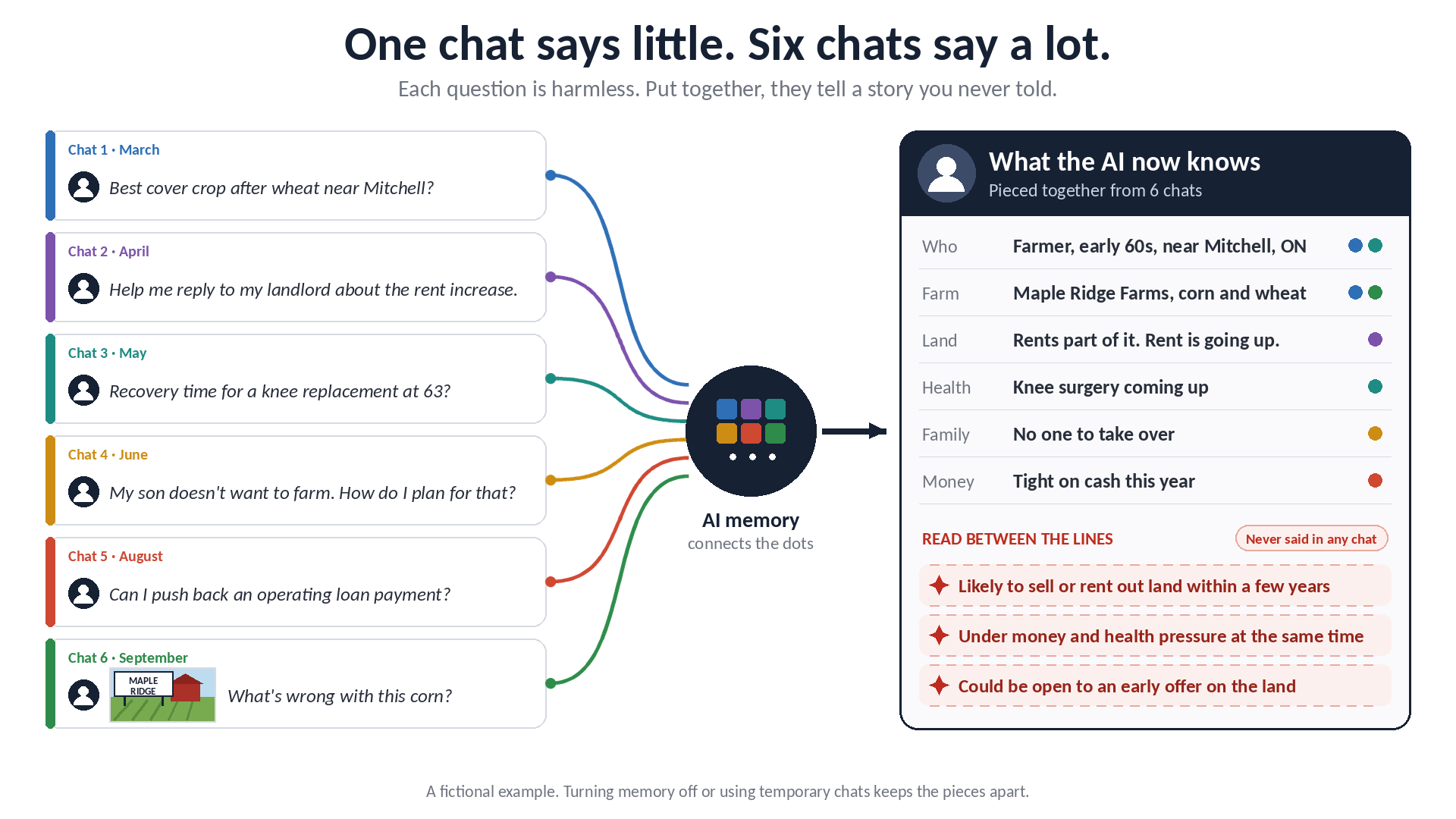
Put together, those pieces say: a farmer in his early 60s near Mitchell, renting part of his land, facing surgery, with no successor and tight cash. From there it’s a short step to things nobody typed: likely to sell or rent out land within a few years, under pressure, maybe open to an early offer.
Why would anyone want that picture? Not for science-fiction reasons. Knowing who you are, what pressure you’re under and what you might do next is exactly what ad systems and recommendation engines are built to use. It shapes what you’re shown, what you’re offered, and when. Social media has worked this way for years. Some AI companies have started doing the same with chats, as the next section shows, and a chat usually holds far more than a post.
This is the tricky part of AI privacy. The context that makes AI useful is the same context that builds the profile. You never feel like you’ve overshared, because no single chat crosses the line.
Where your chats can end up
Forget the science-fiction scenarios. These are real, documented paths. Most are side effects of ordinary features, business models and the law, not bad intent. Some stay inside the AI company. Others lead outside it.
Inside the AI company
- 1
Into the AI’s memory
Memory is designed to remember you, so future answers can be personalized. That’s handy, and it’s also how the mosaic forms.
- 2
Into ad systems
Since December 16, 2025, Meta has used people’s chats with Meta AI to personalize ads and content on Facebook, Instagram and WhatsApp, with no opt-out outside the EU, UK and South Korea. ChatGPT now shows ads on its Free and Go plans, with plans to reach Canada. Ads are matched to your conversation, past chats and memory. OpenAI says advertisers never see your chats, and you can turn off that personalization.
Documented: The Register · OpenAI - 3
In front of human reviewers
Google has people review a sample of Gemini conversations. Reviewed chats are kept for up to three years, separate from your account, and deleting your activity doesn’t remove them.
Documented: Gemini Apps privacy hub - 4
Into your employer’s account
On a work or business account, your organization sets the rules. Keep personal matters off it.
Please don’t enter confidential information that you wouldn’t want a reviewer to see…
Outside the AI company
- 5
Into a court case
In 2025, a U.S. court ordered OpenAI to preserve ChatGPT output logs, including chats users had deleted, as part of the New York Times lawsuit. OpenAI’s CEO has said plainly that ChatGPT chats have no legal privilege like a conversation with a lawyer or therapist. Think land disputes, estates and separations.
Documented: Malwarebytes · Benzinga - 6
Into a third-party app’s database
Many AI apps are “wrappers”: their own app on top of ChatGPT, Claude or Gemini, with their own storage and security. In early 2026, one such app, Chat & Ask AI, left a database open that exposed about 300 million messages from 25 million users.
Documented: Malwarebytes - 7
Onto the open web
In 2025, thousands of shared ChatGPT conversations turned up in Google search results. OpenAI pulled the feature, calling it a “short-lived experiment.” Be careful with share links.
Documented: Fortune
If you go talk to ChatGPT about your most sensitive stuff and then there’s like a lawsuit or whatever, like we could be required to produce that.
Other people’s information isn’t yours to share
Your spouse’s health, your kids’ plans, your landlord’s terms, an employee’s pay: they didn’t agree to be in your chat.
For CCAs and farm office staff, this is also a professional issue. A client’s soil test, yields or finances pasted into a personal AI account may break your employer’s rules or your professional obligations. Check your organization’s policy before you do it, and use placeholders like “Client A” when you can.
Why this isn’t a reason to quit AI
After all that, it would be easy to decide AI isn’t worth the risk. That would be the wrong lesson.
The same is true of email, online banking and your phone. They all carry risk, and we use them anyway, because we’ve learned a few habits that keep the risk small. AI is no different. It’s just newer, so the habits aren’t second nature yet.
And the habits are simple. Most of the protection comes from a handful of settings you can check in ten minutes, and a way of asking that keeps your situation in and your identity out. You keep nearly all of the benefit.
Key takeaways
- AI isn’t a search box. It listens like a person, remembers, connects the dots and keeps what you say.
- Privacy is a spectrum. Red is easy to keep out. The real risk is the orange middle: details that are harmless alone and revealing together.
- The mosaic effect is real. Small pieces across many chats can add up to a profile, including conclusions you never stated.
- Your chats travel further than you think: memory, ads, human reviewers, work accounts, court cases, third-party apps and the open web.
- The rule: share your situation, not your identity. Let AI learn from you if you like, but not about you.
This guide is practical advice, not legal advice. AI companies change their features and policies often; the details here are as of November 2026. For legal questions, or obligations around client data, talk to a lawyer or your professional association.
Frequently asked questions
Is ChatGPT safe for farmers to use?
For most farm work, yes. The risk isn’t in asking about crop rotations or market letters. It’s in sharing personal and identifying details, especially across many chats. Part 2 shows the settings and habits that keep that risk small.
Does ChatGPT remember what I tell it?
It can. ChatGPT, Gemini and Claude all offer memory features that save facts about you for later chats. You can view, delete or turn off memory in the settings, and temporary chats aren’t remembered.
What should I never tell an AI chatbot?
Your SIN, health card number, credit card or bank details, passwords, and your full name with your address. Be careful with anything that identifies other people too.
Can my AI chats be used in court?
They can be preserved and requested as evidence. Chats with AI have no legal privilege like a conversation with a lawyer, so treat them like any other written record.
Are my AI chats used for ads?
Sometimes. Meta uses chats with Meta AI to personalize ads, and ChatGPT’s Free and Go plans show ads matched to your conversations. OpenAI says advertisers don’t see your chats.
Want help with AI privacy on your farm or team?
In our hands-on workshops, growers, CCAs and farm office teams check their settings together, practise rewriting real prompts, and leave with a one-page privacy checklist. We also build custom AI privacy training for co-ops, retailers and consulting teams handling client data.
Book a workshopSources
- Gemini Apps privacy hub (Google)
- ConductAtlas: Gemini Apps Privacy Notice, confidential information warning
- The Register: Meta to use AI chats for ads (Oct 2025)
- OpenAI: Testing ads in ChatGPT (updated May 2026)
- Malwarebytes: Court orders OpenAI to preserve ChatGPT chats (Jun 2025)
- TechCrunch: Altman on no legal confidentiality for ChatGPT (Jul 2025)
- Benzinga: Altman, “we could be required to produce that” (Jul 2025)
- Malwarebytes: Chat & Ask AI leak, 300 million messages (Feb 2026)
- Fortune: Shared ChatGPT chats in Google search (Aug 2025)
- Anthropic: Claude chat search and memory