This summer, a farmer in China asked an AI chatbot how to deal with weeds in his sesame. He sprayed the mix it suggested across 25 acres. By morning the crop was dead, and so were the weeds (TechRadar, Aug 2026).
That same year, a Top Producer of the Year winner told Farm Journal he uses AI to double-check every spray application: rate, tank mix, nozzles and pressure (Drovers, Apr 2026). Same kind of tool, opposite result. The difference wasn’t the AI. It was how each farmer used it.
So it’s no surprise trust is low. Only 6% of farmers say they trust AI to help make farm decisions, against 56% who rely on their agronomist (McKinsey via RFD-TV, Sep 2026). In Purdue’s June 2026 survey, 52% of U.S. farmers saw no meaningful benefit from AI tools (Purdue Ag Economy Barometer). Yet 23% of North American farmers already use ChatGPT-style tools.
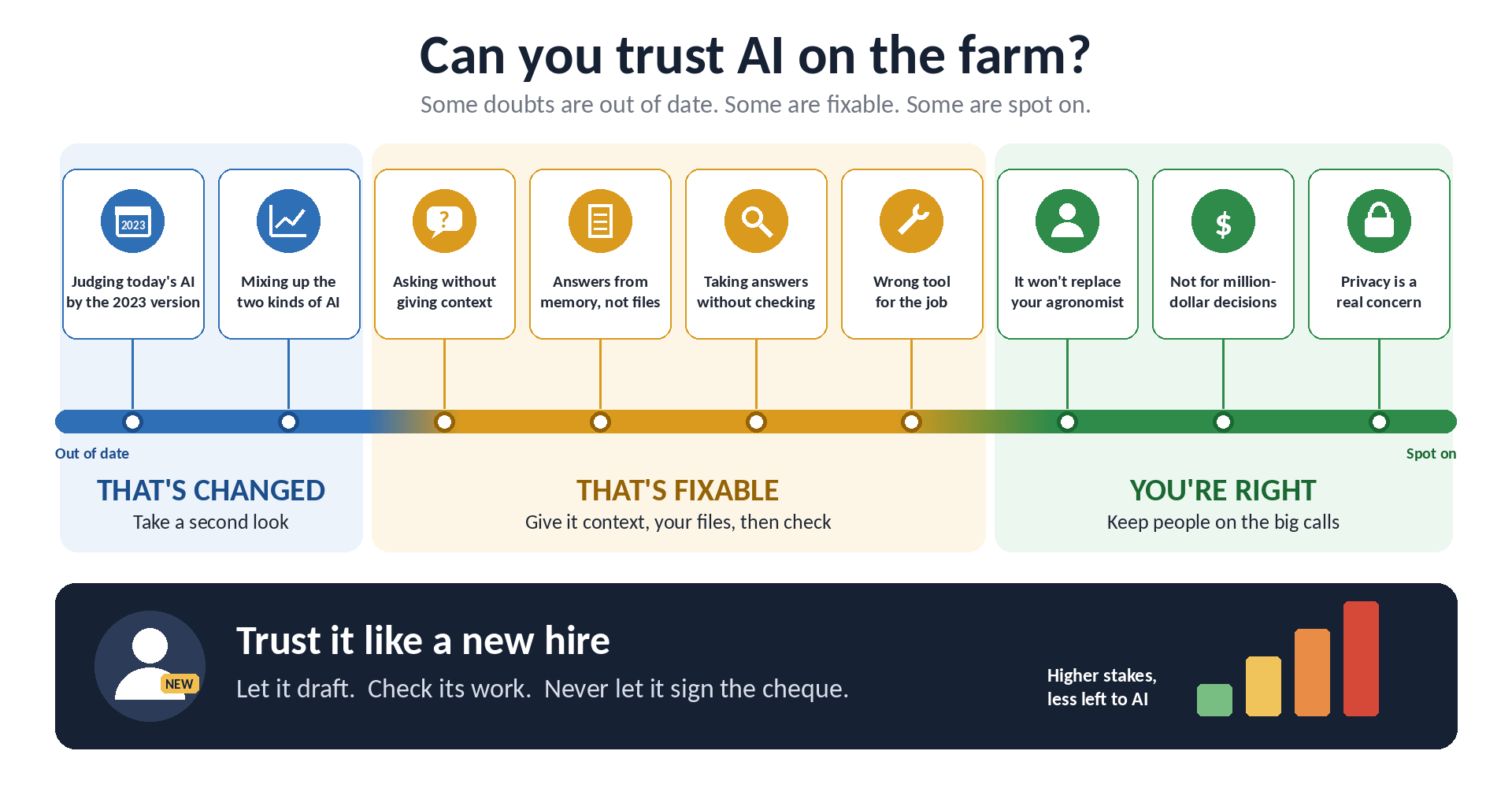
Who’s right, the skeptics or the users? Both. Distrust of AI isn’t one problem. Some doubts are out of date, some come from mistakes you can fix, and some are spot on.
The short version
- The problem: AI can give confident, wrong answers, and on a farm those can cost a crop.
- Out of date: if you judged AI in 2023, you judged a different tool. Today’s versions read your files, check the label and show their sources.
- Fixable: most bad answers come from how we ask. Give context, point it to the source, ask for the quote, then check it.
- Spot on: AI won’t replace your agronomist, shouldn’t make the big calls, and your private data needs care.
- The rule: trust it like a new hire. Let it draft, check its work, never let it sign the cheque.
The zones below follow the image from left to right. The lines between them blur, so read them as a spectrum, not boxes.
Zone 1: That’s changed. Doubts that are out of date
These doubts were fair when they formed. The tools have moved on since.
“AI got my yield forecast wrong, so I don’t trust ChatGPT”
“AI” covers very different tools. The yield model in your farm software, the camera on a weed-spotting sprayer and the autosteer on your tractor are all AI. So is ChatGPT. They learn from different things and do different jobs.
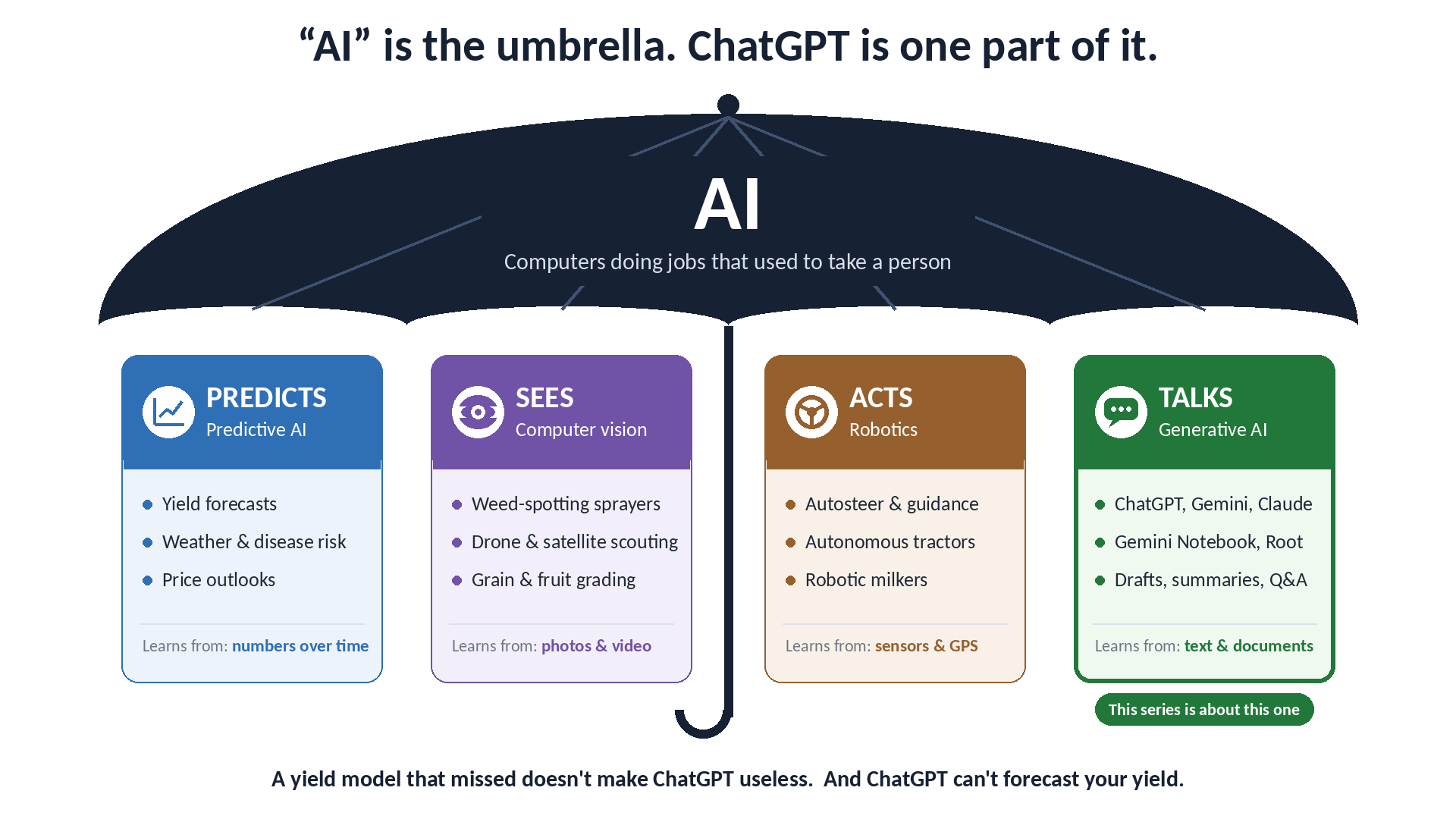
A forecast that missed tells you nothing about how well ChatGPT summarizes a lease. And ChatGPT can’t forecast your yield. This series covers the “talks” kind only: tools that read, write and answer questions.
“I tried ChatGPT in 2023 and it was useless”
If you tried it in 2023, you tried a different tool. The first ChatGPT answered from memory only. It couldn’t open your files, look at a photo, search the web or tell you where an answer came from.
Today’s versions can do all of that. They can read a few hundred pages at once, sometimes well over a thousand: your soil tests, manure analysis and crop plan together. Most importantly for trust, they can show their sources, so you can check them.
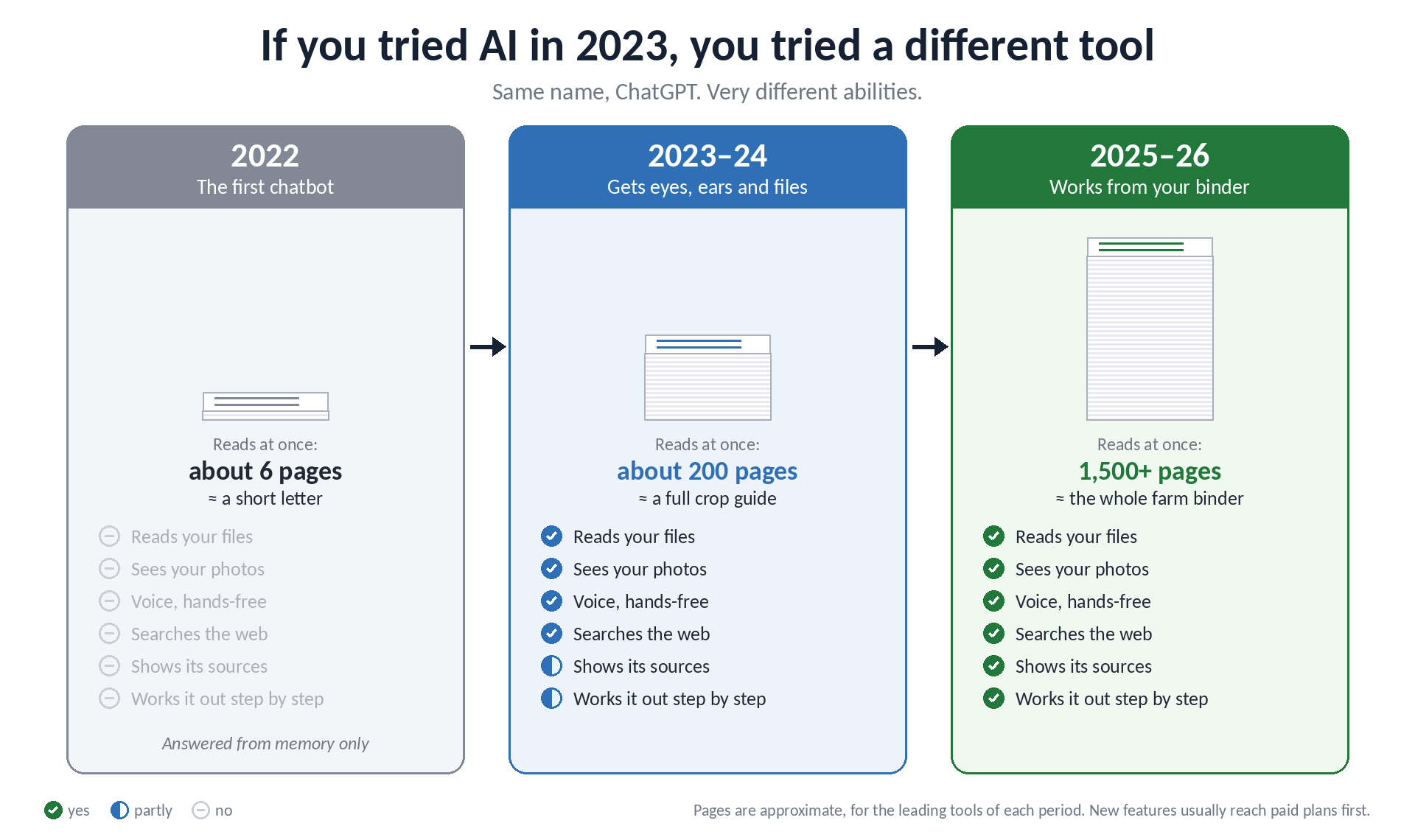
What to do: give it one more try, on a real task, with the newer features turned on. Write up a meeting, or summarize a market letter. Then judge it on that, not on what you saw in 2023.
Zone 2: That’s fixable. Why ChatGPT gives wrong answers, and how to fix it
This is where most bad experiences come from. The tool isn’t broken. It’s being asked to do a job without the information it needs.
What going wrong looks like
The failures are real and well documented:
- Spray advice that killed the crop. The sesame farmer’s chatbot recommended a broadleaf herbicide for a broadleaf crop. The app even warned, “AI generation may be incorrect, please verify.” He didn’t (TechRadar).
- Label questions scored a fail. Extension weed scientists asked four chatbots 24 weed control questions. ChatGPT scored best overall at 60%. On reading labels, the big-name bots scored 19 to 33%, and they rarely cited sources (GROW, Battle of the Bots, Mar 2026).
- Five wrong products out of six. Asked about armyworm insecticides for California rice, ChatGPT listed six. Only one is actually used there (UC ANR).
- Close to home. A Manitoba Co-operator editor tested Root, FCC’s free farm AI. Asked about resistant kochia, it pointed to a Palmer amaranth fact sheet. Asked for a CWRS wheat price, it quoted Minneapolis (Manitoba Co-operator).
The pattern is the same each time. The AI answered from memory, with no source, and sounded sure. Here are four fixes, in the order you’d use them.
Fix 1: Give it your farm’s context
“What’s the N rate for corn?” gets a textbook average. “Corn after soybeans, sandy loam, Perth County, hog manure applied last fall” gets an answer about your field. Say where you farm, what crop, and what you’ve already done.
See prompting with farm context.
Fix 2: Make it answer from your files, not memory
Upload the documents that hold the answer: the soil test, the label, the lease. Then ask it to answer only from those. This one habit removes most of the guessing.
See Stop AI guessing: make it answer from your farm documents.
Fix 3: Make it show its work
Ask for the exact quote and the page number behind every number. Then push back: “What aren’t you sure of?” A good answer you can check in 30 seconds beats a confident one you can’t check at all.
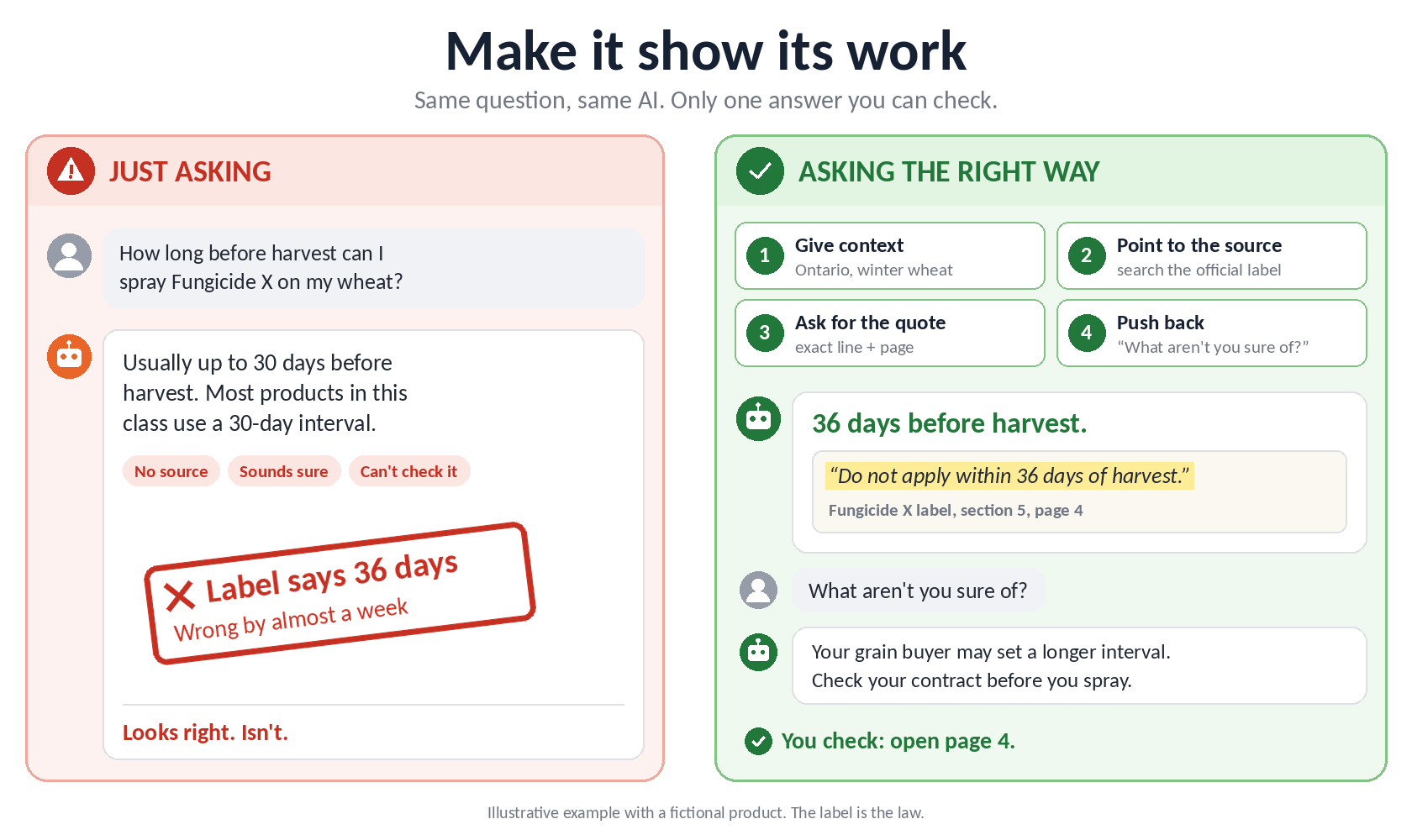
Then do the check. Open page 4 and read the line yourself. For a pesticide, the label on the jug is the law, not the chatbot. In Canada, current labels are on Health Canada’s label search (Health Canada Pesticide Label Search).
Fix 4: Use the right tool for the job
A chatbot without web search can’t know today’s price or this week’s weather. A general chatbot isn’t the best place for Ontario-specific agronomy either. Match the tool to the question:
| You need | Use |
|---|---|
| Answers from your own documents | A document tool such as Gemini Notebook, or a ChatGPT, Claude or Gemini project with files |
| Labels, prices, current rules | A chatbot with web search on, plus the official source |
| Ontario agronomy | OMAFA guides such as Publication 811 and your CCA. AI can help you find and summarize them |
| Drafting, summarizing, notes | Any of the main chatbots |
See choosing the right AI tool.
I farm [crop] in [county], Ontario. [Your situation in one or two lines.] Using only [the attached files / the official label], answer: [your question]. Quote the exact line and page for every number. Then tell me what you’re not sure of.
Zone 3: You’re right. Where AI shouldn’t be trusted
Some skepticism is just good judgment. These are the red lines, and no prompt fixes them.
It won’t replace your agronomist
AI knows what’s written down. Your agronomist knows your fields, your history and this season. Cornell weed scientist Lynn Sosnoskie puts it plainly: AI tools “lack the local agronomic knowledge and judgment that trained professionals bring” (Cornell CALS).
Use AI to make that relationship better. Summarize your scouting notes before the call. List your questions. If you’re a CCA, let it draft the client report, then put your name on what you’ve checked.
It shouldn’t make the big calls
Land, leases, a new combine, a fungicide program over 2,000 acres: when a mistake costs real money, AI is a sparring partner, not the decision maker. One award-winning grower uses it to “pressure test” ideas “before it costs me real money” (Drovers). He still makes the call.
Farmers already sense this. In a 2026 survey, the top trust builders were real-world farm results (62%) and the ability to override the AI (30%) (MorganMyers / Ag Access via Iowa Capital Dispatch). In other words: you stay in charge.
Your private data needs care
This concern is real. Some tools can use your chats to improve future models unless you switch that off (ChatGPT data controls). Before you upload anything, sort it like a traffic light.
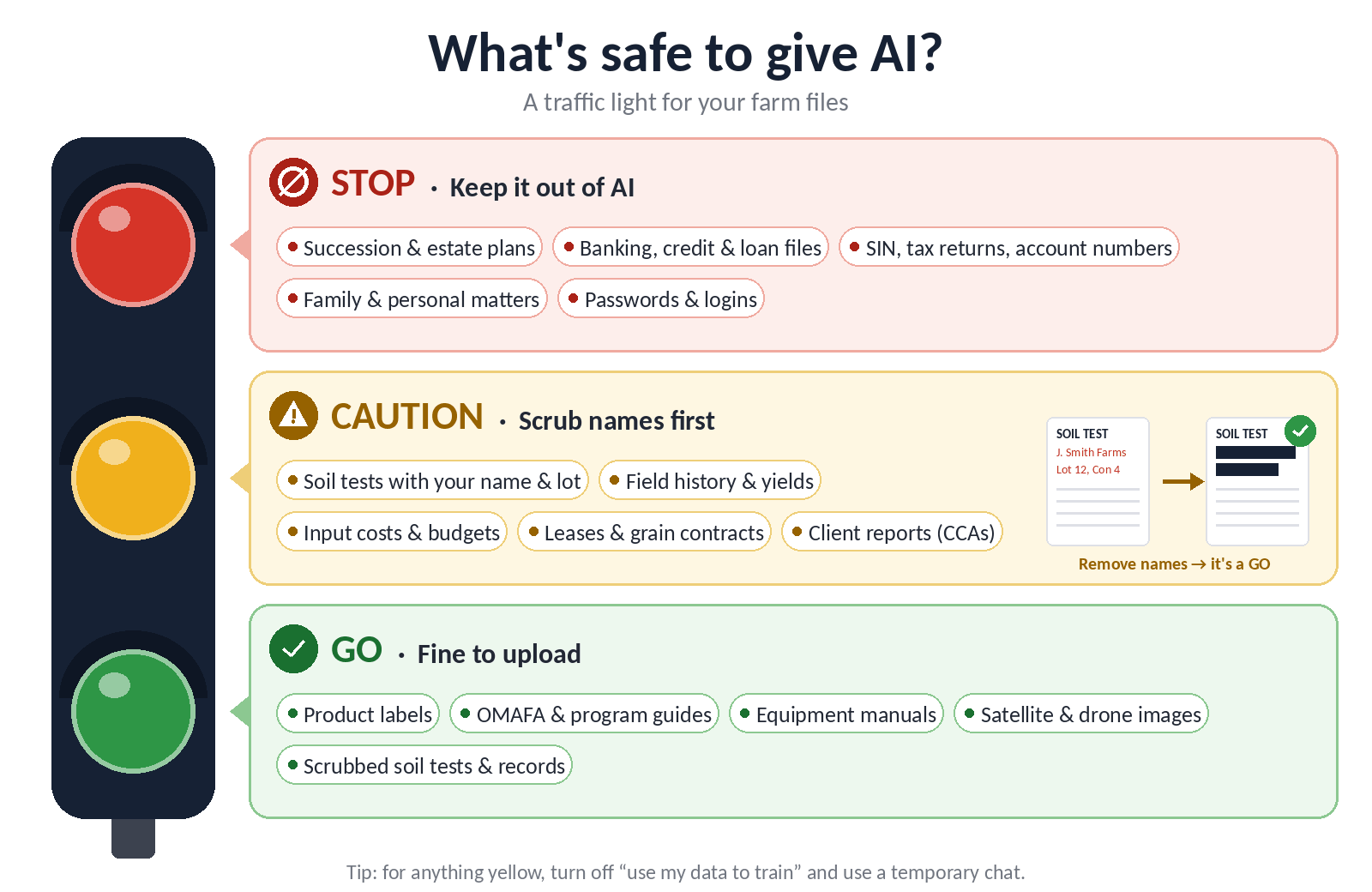
Green: public documents like labels and OMAFA guides. Yellow: soil tests and field records, with names and locations removed. Red: succession plans, financial statements and anything personal.
Farm document scrubber: coming soon
See also: AI privacy for farms.
The trust ladder: how much to leave to AI
So should you trust AI on the farm? Trust it the way you’d trust a sharp new hire. On day one you’d let them write emails and tidy the books. You’d check their numbers. You wouldn’t let them sign a land deal. How far you lean on AI depends on what’s at stake.
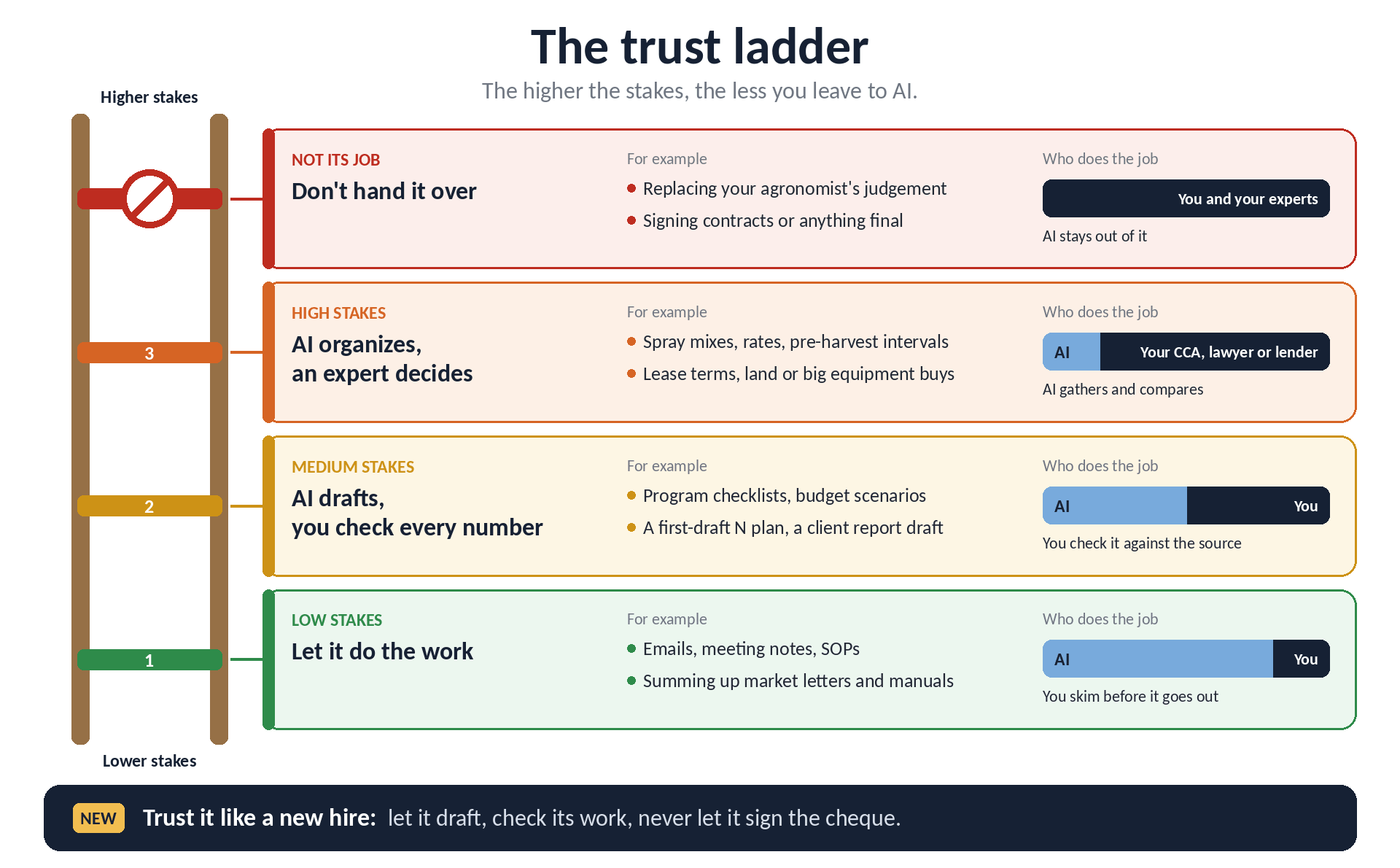
- Low stakes: let it do the work. Emails, meeting notes, SOPs, a summary of this week’s market letters. Skim it before it goes out.
- Medium stakes: AI drafts, you check every number. An AgriStability checklist, a budget scenario, a first-draft nitrogen plan. Check each figure against its source.
- High stakes: AI organizes, an expert decides. Spray mixes and pre-harvest intervals, lease terms, a land or equipment purchase. Let AI gather and compare. Your CCA, lawyer or lender makes the call.
- Not its job: don’t hand it over. Replacing your agronomist’s judgement, or signing off on anything legal or final. AI stays out of it.
Most of the payoff sits on the bottom two rungs, and that’s where to start. Pick one task you dislike at the end of the day and give it to AI this week.
Frequently asked questions
Can farmers trust ChatGPT?
For low-stakes jobs like emails and summaries, yes, with a quick skim. For anything with numbers, rates or money attached, only after you check the answer against its source. Never for decisions your agronomist, lawyer or lender should make.
Why does ChatGPT give wrong answers?
When it answers from memory, it predicts what a good answer sounds like. Sometimes that’s wrong but confident, which is called a hallucination. Giving it your documents and asking for sources cuts this sharply.
How do I fact-check an AI answer?
Ask it for the exact quote and page behind each number, then open that page and read it. Also ask, “What aren’t you sure of?” If it can’t point to a source, treat the answer as a guess.
Is it safe to ask AI about pesticides or spray rates?
AI can help you find and read the label faster. It should never be your only source. The label is the law, so confirm every rate, mix and pre-harvest interval on the current label before you spray.
Will AI replace my agronomist or CCA?
No. AI doesn’t know your fields or this season, and it can’t take responsibility for a call. It can save your agronomist time, and save you time getting ready for the conversation.
Is my farm data safe in ChatGPT?
It depends on the tool and your settings. Turn off model training where you can. Remove names and locations from soil tests and records, and keep financial and personal documents out entirely.
Is ChatGPT the same as AI?
No. ChatGPT is generative AI, the kind that reads and writes. Yield forecasting, weed-spotting cameras and autosteer are other kinds of AI that work very differently.
Want help putting this to work?
We run hands-on AI workshops for growers, CCAs and farm office teams in Ontario. Bring your own documents and leave with prompts and tools you’ll actually use. We also build custom training for co-ops, retailers and consulting teams.
Book a workshopSources
- TechRadar: farmer loses 25 acres of sesame after AI herbicide advice (Aug 2026)
- Drovers: farmers don’t use AI for answers, they use it to think better (Apr 2026)
- RFD-TV: McKinsey 2026 farmer survey, AI use and trust (Sep 2026)
- McKinsey: Global Farmer Insights 2026 (full report PDF)
- Purdue Ag Economy Barometer, June 2026
- Iowa Capital Dispatch: MorganMyers / Ag Access survey (Jun 2026)
- GROW: Battle of the Bots (Mar 2026)
- UC ANR: be wary of relying on ChatGPT for agricultural questions
- Manitoba Co-operator: Root AI farm assistant put to the test (Jul 2025)
- Cornell CALS: use caution with AI-guided weed management
- Health Canada Pesticide Label Search
- OMAFA Publication 811: Agronomy Guide for Field Crops
- OpenAI: ChatGPT data controls FAQ